economics blog

Economics Help.org Revision Guide

Model Economics Essays

inflation — Economics Blog

Entries Tagged 'inflation' ↓

Solution to Stagflation

Readers Question: what is the solution for stagflation?

Stagflation occurs when there is an increase in inflation and an increase in unemployment and lower growth.

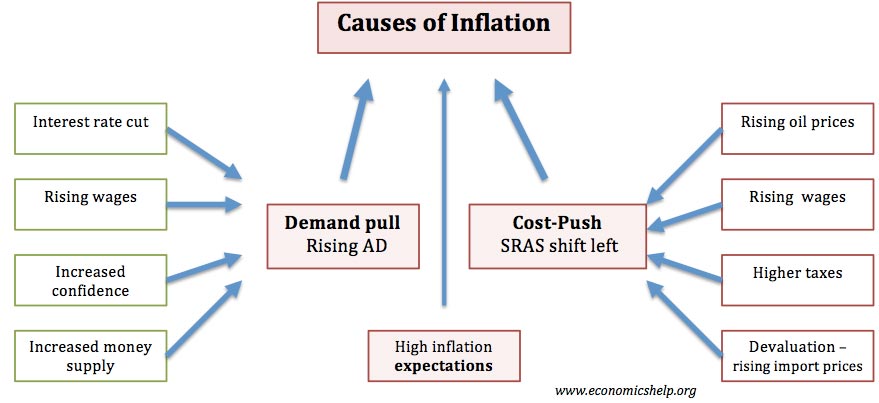
Typically stagflation will be caused by an increase in the cost of production which shifts the AS curve to the left.

Diagram of Stagflation

cost push inflation

The diagram shows that the stagflation causes the price level to rise from P1 to P2. Output falls from Y1 to Y2

How To Solve Stagflation?

It is not easy. For example You could use Monetary policy to reduce inflation. Higher Interest rates increase the cost of borrowing and will reduce AD. This will be effective for reducing inflation, but, it will cause a  bigger fall in GDP. Continue reading →

Information on Inflation

1) Readers Question What is inflation,

 How is inflation calculated?

 and impact on economy if it bit increases or decreases.

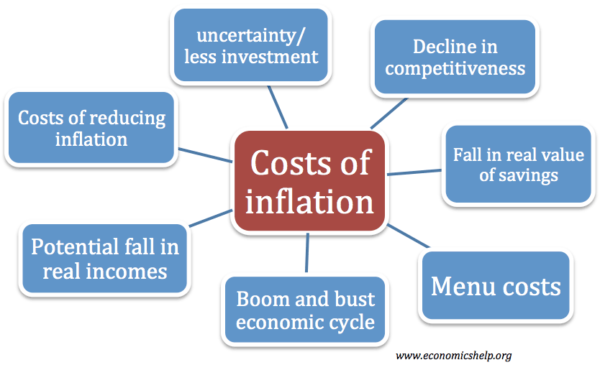
If inflation increases above the governments target of 2% it is said to have various economic costs, such as creating instability, uncertainty and lower international competitiveness. See costs of inflation 

If prices fall, then we have deflation. Deflation can be harmful if it leads to lower demand. See: impact of inflation and deflation 

Canadian Monetary Policy and Inflation

Readers Question: suppose you are the governor of the bank of canada .. and that inflation has been high and roughly constant for a number of years. you have two policy choices : you can attempt to eliminate the sustained inflation . Outline the issues involved when making this choice. list and explain the costs of ongoing inflation, and also the costs of a potential disinflation. explain how you make your policy decision.

There is only one choice in this question - eliminate sustained inflation. I guess the alternative is to allow the inflation to continue and target higher economic growth.

Costs of Inflation.

If Canada has high and sustained inflation it will have the following costs:

  1. Discourages investment. High levels of inflation create uncertainty and lead to lower investment levels. Countries with higher inflation rates tend to have lower rates of economic growth in the long term.
  2. Falling International Competitiveness. If Canada has a high rate of inflation then it is likely that they will be losing international competitiveness. This will cause lower exports and potentially higher unemployment.
  3. Menu costs / Shoe leather Costs. These may not be too high in a modern economy, but, they involve the costs of changing price lists and looking for the best valued prices.

See: More Detail on the Costs of Inflation

Therefore these costs suggest there is a good reason for the Bank of Canada to use monetary policy to try and reduce inflationary pressures. This will involve increasing interest rates. Higher interest rates will

  • Make borrowing more expensive
  • Reduce disposable income of those with mortgages
  • Make saving more attractive
  • Lead to an appreciation in the Canadian currency (because of attracting hot money flows)

This has the effect of reducing Investment, consumer spending, AD and economic growth. This will reduce inflation but at the cost of lower growth, higher unemployment and possibly a recession. The slowdown in growth will also lead to higher government borrowing because people will pay lower tax and the government spend more on benefits.

Exporters will be adversely affected by the rise in the exchange rates as it makes exports less competitive.

The only benefit is that it will improve the current account because it reduces import spending.

Continue reading →

Hyper Inflation in Zimbabwe

Readers Question: If inflation is too much money, too few goods then how come…..Zimbabwe has the world’s highest inflation rate, at more than 100,000%, and just one adult in five is believed to have a regular job? With no job, no money so no demand so…why inflation?

I don’t have much information on the Zimbabwe economy but a likely explanation for the situation in Zimbabwe could be the government printing money and thereby increasing the money supply much faster than Real GDP.

A few years ago, national debt in Zimbabwe increased to over 100% of GDP. To finance the National Debt, the Government started printing money; but, this only devalued the value of existing money and caused prices to rise.

The inflation is also exacerbated by a shortage of supply. Because basic goods are in short supply it is easy for market prices to be increased causing a spiral effect of upwardly rising prices.

Ironically, this shortage of supply has been made worse by the imposition of price controls. These fix prices for basic goods. But, because the cost of production has been increasing faster than prices, suppliers have little incentive to supply (at least to official channels). This makes the shortage worse and therefore the likelyhood of inflation stronger.

  • Note: I think that there is ‘weak demand’ rather than ‘no demand’ Some people still have the ability to buy goods; the problem is that the supply of goods is still less than the very ‘weak’ demand.
  • Also, the thing here is that there is little ‘effective demand’. i.e. people want to purchase goods, they just don’t have the necessary income to be able to do it. Leading to tragic consequences such as Funeral Costs soar

Continue reading →

Bank of England Inflation Target

Readers Question: What credit can the adoption of central bank independence take for the relative stability of the UK business cycle since 1997?

The MPC, Bank of England,  are responsible for setting interest rates and determining UK monetary policy. They seek to keep inflation close to the government’s target of CPI 2% +/-1 %

Since 1997, the UK has enjoyed a period of unbroken economic growth and low inflation. It appears that the UK has been able to avoid the ‘boom and bust‘ economic cycles that characterised the boost way period - most notably the Lawson boom of the late 80s and following recession.

The statistics on inflation and economic growth are impressive, especially when put in historical context. It is a good question to ask how much we can credit the independence of the Bank of England?

Why the MPC has helped keep inflation on target.

1. They are independent. They are not subject to political pressures. E.g. they are not tempted to cut interest rates just before an election. This used to be a problem for UK economy, with many experiences of boom and bust economic cycles.

2. Monetary Policy is pre-emptive. They try to prevent inflation before it occurs. They predict future inflation trends. If inflation looks to be increasing above the target of 2%+/-1 then they can increase interest rates to reduce consumer spending and keep inflation on track. Continue reading →

Inflation Target and Monetary Policy

Readers Question: Explain how monetary policy works under an inflation targeting Regime.

I have written some answers to this question on previous occassions. These answers should help:

Meaning of Inflation Targetting

Inflation Targetting means that the Central Bank has a sole objective of achieving the Government’s inflation target. This means in theory they do not target other macroeconomic objectives like unemployment and growth (although in practice they may worry about a recession).

It also means they don’t target inflation indirectly. e.g. fixing currency or targetting money supply. Continue reading →

Effects of A Falling Inflation Rate

Readers Question: Evaluate the possible consequences of a falling rate of inflation for the performance of the UK economy.

A falling rate of inflation means that prices will be rising at a slower rates.

It depends on why the inflation rate is falling. If inflation falls from 2.5% to 1.5% as a result of falling aggregate demand, then the UK will experience lower economic growth and possibly recession. This will be harmful and lead to higher levels of unemployment.

If the rate of inflation keeps falling the UK may experience deflation, this will cause further problem, when prices fall people are reluctant to spend because goods will be cheaper in the future. Therefore, there is even slower growth (like Japan).

However, if inflation falls because of increased productivity and better technology. This means that the AS curve will shift to the right. It means that the UK will benefit from both lower inflation and higher growth. For example, new computer technology means prices are falling and we benefit from better equipment. Continue reading →

Unemployment and Inflation Rates in UK

Readers Question: how the unemployment and inflation is related to country’s economy

If we take the example of the UK, we can see differing examples of how unemployment and inflation are related to a country’s economy. The key to this question is what causes unemployment and inflation. There are several different factors, but it is important to consider both demand side and supply side factors.

Unemployment and Economic Growth. The most obvious factor is that higher economic growth will reduce unemployment. Since 1992, the UK has experienced a long period of economic growth, causing a fall in demand deficient unemployment. Unemployment in 2007 was just under 1 million. In 2008, the unemployment rate has continued to fall; it is about 4% of the labour force (depending on which method you use.) However, in the recession of 1981 (negative growth) unemployment rose to 3 million. Unemployment also rose to 3million in 1992.

Continue reading →

Inflation: Advantages and Disadvantages

Readers Question: what are the advantages and disadvantages of inflation???

The advantages of inflation:

1. Deflation is very harmful. For example, the Japanese economy has suffered lower growth because of deflation. When prices are falling people are reluctant to spend money because they are concerned that prices will be cheaper in the future, therefore, they keep delaying purchases. There are many more cost of deflation in this essay on

is Inflation beneficial?

Disadvantages of Inflation.

Inflation is considered to be a problem when the inflation rate rises above 2%. The higher the inflation, the more serious the problem is.

  • In a modern economy, the Government are most concerned about the destabilising impact of inflation.
  • Inflationary growth tends to be unsustainable leading to a damaging period of boom and bust economic cycles.
  • Inflation tends to discourage investment and long term economic growth.
  • See also: Costs of Inflation 

CPI RPI Inflation in UK

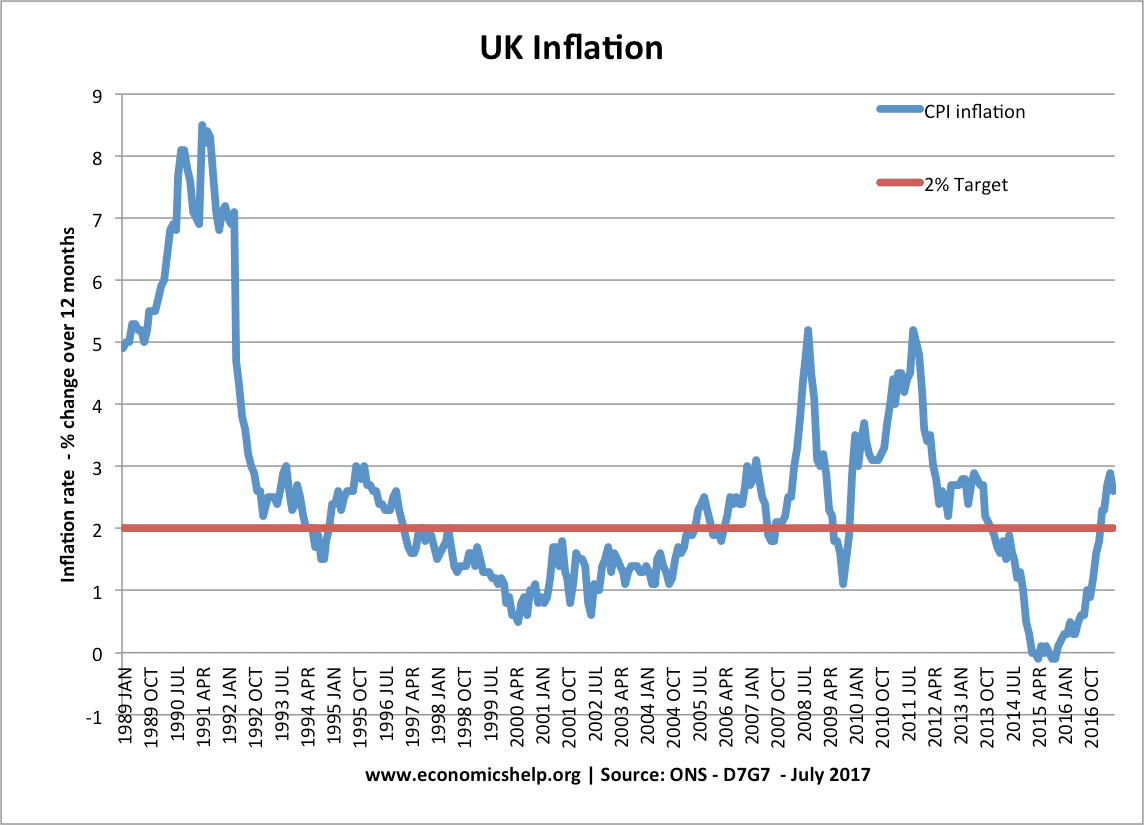
Despite predicted slowdown in UK economic growth, UK inflation in 2008 has slightly increased above the government’s target of 2%.

There is also an increasing gap between CPI inflation and RPI inflation

inflation

source: ONS

Continue reading →