Should the Legal Drinking Age be Increased to 21?

Readers Question: Evaluate the case for raising the legal drinking age to 21. Will it be more effective than other methods for reducing the harmful effects of alcohol? 

There are several reasons to be concerned about the over-consumption of alcohol, especially amongst young people. In the UK, abuse of alcohol has contributed to several social, economic and health problems, including:

  • Alcohol related accidents.
  • Health problems
  • Alcohol addiction major cause of family breakdown.
  • According to a report, “Health First: An evidence-based alcohol strategy for the UK”. “The personal, social and economic cost of alcohol has been estimated to be up to £55bn per year for England and £7.5bn for Scotland,”
  • Research carried out by Sheffield University for the government shows a 45p minimum would reduce the consumption of alcohol by 4.3%, leading to 2,000 fewer deaths and 66,000 hospital admissions after 10 years. Researchers also claim the number of crimes would drop by 24,000 a year.

From an economic perspective, we say that alcohol is a demerit good.

  1. People may underestimate the personal costs of drinking alcohol to excess (especially amongst young people)
  2. There are external costs to society, e.g. costs of health care, costs of treating accidents, days lost from work. Therefore the social cost of alcohol is greater than the private cost.

These two factors give a justification for government intervention to deal with some issues related to alcohol.  Raising the legal drinking age could help reduce these personal and social costs because it is more difficult to purchase.

Arguments against raising the drinking age to 21

  • At 18, people can vote and are considered adults, so we should allow them to have a personal decision on whether to consume alcohol.
  • Alcohol in moderation isn’t necessarily harmful. Rather than a blanket ban, the government could focus on tackling binge drinking through making alcohol more expensive and tackling the drinking culture.
  • Drinking alcohol is so embedded in the culture, raising the legal age to 21, will make the majority of young people break the law.
  • It will encourage people to find ways to circumnavigate the law. Black market alcohol supplies, which may be harder to monitor.
  • Arguably, there are better ways to deal with problems of alcohol.

Will Raising the drinking age to 21 be effective?

Raising the drinking age to 21 will reduce consumption amongst young people because it will be harder to buy alcohol. Also, young people are the most likely group to misuse alcohol; e.g. drinking to excess, which causes accidents, death and health problems. If people start drinking later in life, they may be more likely to drink in moderation and not get addicted at an early age.

However, it will still be possible for young people to drink at home. People will find ways to avoid the legislation e.g. asking older people to buy alcohol for them. Nevertheless, it will be more difficult. For example, a 16 year old may not be able to get away with drinking in a pub any more. If the age is 18, it is much easier for a 16 or 17 year old to get away with drinking alcohol.

This policy doesn’t address the underlying problem of why people want to drink to excess. For that education may be a better solution; education could  help to explain the dangers of excess drinking and therefore encourage young people to drink moderation.. However, previous education policies have not seemed to be very effective. Young people don’t want to hear lectures from the government about the dangers of alcohol.
Continue Reading →

Comments { 80 }

Credit Policy

Credit policy / financial policy is the use of the financial system to influence aggregate demand (AD). Monetary policy affects AD through the Central bank controlling interest rates and the money supply. Fiscal policy affects AD through the use of government spending and taxation.

Credit policy looks at factors such as:

  • Bank lending rates to firms and households in the economy.
  • The supply of credit and availability of loans from banks to firms and households.

In normal economic circumstances, it was felt the Central Bank could adequately control the economy through changing base rates.

When the Central Bank (e.g. ECB, Bank of England) changed interest rates, it had a strong influence on bank lending rates. When the ECB cut rates in 2001-03, bank lending rates fell, when the ECB raised rates in 2006-07, bank lending rates rose. Bank lending rates closely mirrored the Central Bank. Therefore, there was little attention paid to bank lending rates – there was no need.

However, since the credit crunch, the normal relationship between Central bank base rates has broken down. In particular, when the main base interest rate was cut, firms – especially small and medium sized firms (SME) didn’t see the actual interest rate they paid cut.

base-rates-bank-rates

See also bank and base rates in the UK

Implications of divergence between base rates and bank rates

This is very important for the effectiveness or not of monetary policy. Usually, if interest rates are cut from 5% to 0.5%, we would expect the loosening of monetary policy to boost lending, consumption and aggregate demand. But, that hasn’t been happening. Lending rates are still high, and credit tight. The base rate of 0.5% has become misleading to the actual reality of firms who face high borrowing costs.

Problems in the Eurozone

bank costs

Source: Economists – Central bank has lost control over interest rates

This problem of bank lending rates is most noticeable in the peripheral Eurozone countries. Since the crisis, small and medium sized firms have actually seen an increase in borrowing costs. Bank rates have increased, making the 0.5% ECB rate meaningless. The Economist reports

‘SMEs in Spain and Italy must pay over 6% to borrow; money is tighter there than it was in 2005, even though the ECB’s rate is far lower.’ (Woes for small business in Europe)

The problem for SME (small and medium enterprise firms) is that they are too small to sell their own bonds. They are reliant on bank lending. But, because of the credit crunch and fears over bank stability, they are finding their borrowing costs increase.

Continue Reading →

Comments { 1 }

Base rates and bank interest rates

The Bank of England set the base rate. This is the rate at which they charge commercial banks to borrow from the Bank of England. In normal economic circumstances, this base rate will influence all the interest rates set by other banks and financial institutions.

  • If the Bank of England cut the base rate, you would expect banks to also cut their mortgage and lending rates.
  • If the Bank of England put up the base rate, you would expect banks to increase their mortgage rates.

uk-base-rate-v-bank-svr-500x336

The reason is that if commercial banks find it more expensive to borrow from the Bank of England, then they increase their lending costs to compensate. If it is cheaper to borrow from the Bank of England, they can reduce their mortgage rates and keep the same profit margin.

However, in the credit crunch, we see a greater divergence between base rates set by the Bank of England and actual bank rates that people in the real world face.

base-rates-bank-rates-mortgage-rates

interest rates at the Bank of England

This graph shows the gap between base rates and the bank rates

base-rates-bank-rates

After 2008, we see the gap between base rates and bank lending rates increases from 2% points to close to 4%. It means that mortgage holders haven’t benefited from the cut in base rates as much as you might expect.

Why gap between bank rates and base rates increased

In 2008, banks were short of liquidity, they wanted to increase their deposits and improve their balance sheets. Therefore, they were reluctant to lend and keen to attract savings. Therefore, they didn’t want to cut mortgage rates and lending rates. In effect, they were making it more profitable; they could borrow from the Bank of England at 0.5%, but they were lending out at 4%.

Interest rates are quantity of funds

Another issue is that the quantity of funds is important. After 2008, it become much difficult to get a loan. Even if interest rates were low, people couldn’t always raise a sufficient deposit to get a mortgage.

Credit policy

This suggests that traditional monetary policy (which focuses on Bank of England base rate) may be insufficient, and we need to have more focus on actual real life interest rates set by commercial banks.

Related


Comments { 7 }

Revising for economic essays

Readers Question: how to revise for a possible exam question like: discuss the likely effectiveness of ‘expansionary fiscal and monetary policies as means of closing the output gap’

Firstly write down the question on a blank piece of paper. Then try and revise in three parts.

Part One – Knowledge  define terms

  • Expansionary fiscal policy – an attempt by the government to increase AD, through increasing government spending and cutting tax, (leading to bigger budget deficit)
  • Expansionary monetary policy – When the Central Bank cuts interest rates or increases money supply, through a policy like quantitative easing.
  • Output gap. This is the difference between potential output and actual output. A negative output gap means that current real GDP is less than potential and therefore there is spare capacity / unemployment.

Part Two – Explain effect of fiscal and monetary policy on output gap

Expansionary monetary policy could involve cutting interest rates. If the Bank of England cut interest rates, this should stimulate aggregate demand. Firstly, lower interest rates reduce the cost of borrowing and therefore encourage consumers to spend on credit. Lower borrowing costs will also encourage firms to invest because it is cheaper to finance investment. Secondly lower interest rates will reduce the amount householders have to spend on mortgage interest payments and therefore they will have more disposable income; this should increase consumer spending. Overall, with higher C and I, we should see an increase in AD.
ad

This increase in AD should lead to higher real GDP and reduce the output gap. At Y1, there is a significant negative output gap, Y1 is less than potential AS. Therefore, increasing AD does reduce the output gap.

Expansionary fiscal policy

The government could decide to borrow from the private sector and use this to spend on capital investment, such as building new roads and railways. This increase in government spending will increase AD and have a similar effect in increasing GDP. Alternatively, the government could cut the rate of VAT, this lower tax will give consumers greater spending power and should hopefully increase consumption; this should also increase AD, leading to great real GDP and reduce the output gap. There may also be a multiplier effect with the initial investment causing a bigger final increase in real GDP.

Part Three evaluation

For evaluation we need to discuss

  • Will these policies actually  be successful?
  • What could determine with monetary and fiscal policy actually close the output gap?
  • What might different economists say?

Evaluation for macroeconomics could involve several factors, such as:

  • Other factors affecting AD
  • Time lags
  • It depends on the state of the economy
  • It depends on side effects of policies implemented.

Continue Reading →

Comments { 0 }

What economic lessons can we learn from Latvia and Estonia?

The Latvian and Estonian economies have recently experienced – an economic boom, a spectacular bust, and recovery. Their experience is a chance to evaluate the merits of fixed exchange rates, austerity and the issues of an economy based on trade and capital inflows.

estonia-latvia-growth

Aspects of the Baltic economies

  1. Boom period between 2000 and 2007
  2. Great recession of 2008-2010
  3. Readjustment policies of fiscal contraction whilst maintaining fixed exchange rate.
  4. Economic recovery from 2011

Lessons from the boom

Both Latvia and Estonia experienced rapid economic growth in the early 2000s. This was helped by various policies and economic factors

  • Free market reforms enabled growth of efficiency and productivity. From 1991, the economies became more market oriented with policies of privatisation and deregulation, enabling greater incentives to be efficient.
  • Latvia and Estonia are both small, open economies where free trade has contributed towards economic growth. In Latvia, exports account for 33% of GDP, including raw materials, such as timber, agriculture and manufacturing products.
  • The open nature of the economy attracted significant capital inflows from Europe. These capital inflows helped to finance a growing current account deficit, which reached 20% of GDP in Latvia and 16% of GPD in Estonia.

latvia

Source: Latvia report, EU

Record levels of economic growth in Latvia, led to a corresponding rise in the current account deficit.

Continue Reading →

Comments { 0 }

Underemployment definition and index

Underemployment is defined as a situation where people are working fewer hours than they wish; e.g. you would like to work 40 hours a week, but the firm only gives you 30 hours. (Underemployment may also refer to the fact workers accept jobs that don’t utilise their skills. e.g. graduate working in McDonalds may be considered to be ‘under-employed’)

According to the Office for National Statistics, there are 2.8 million workers in Britain who are working less hours than they would like (link). This could include people forced to work part time rather than full time. This figure of underemployment has increased during the recession because firms have sought to avoid paying redundancy by reducing working hours and therefore cost of labour.

Underemployment does not have as many costs as official unemployment. But, it does mean the underemployed have lower incomes and so will spend less. Also, under-employment needs to be considered when evaluation the output gap in the labour market and output gap of the economy.

Under-employment in the great recession

A surprising feature of the current recession is the fact unemployment is relatively lower than we might expect. (see: UK unemployment mystery)

Part of the explanation is due to the issue of underemployment.  This rise in underemployment may be due to:

  • Low real wages, therefore workers need more hours to make up for low take-home pay.
  • Firms cutting hours in order to cut costs and stay in business.
  • Underemployment might be seen as an alternative to making workers redundant. It saves the firm having the costs of firing and later rehiring workers.
  • Under-employment may indicate a more flexible labour market with firms able to change worker hours and not be tied by fixed contracts. In one sense workers benefit as unemployment is lower, but it also contributes to declining real wages.

This under-employment is an important indicator because it suggests spare capacity in the labour market and needs to be considered when examining the state of the labour market. For example, if demand in the economy increased, firms could increase hours of the under-employed to increase output, and not have to increase wages.

David Bell and David Blanchflower have created a new index which combines aggregate under-employment with the actual unemployment rate. This gives a wider overall perspective of the labour market.

Also, some workers may be be ‘over-employed’ working more hours than they want, e.g. workers over 50 may prefer lower hours and lower pay. This index takes into account the level of underemployment – over-employment.

Under-employment, Unemployment index

under-employment

Source: Not the Treasury View | Original pdf

The graphs shows how in the boom years, there is little aggregate under-employment. The number of people claiming they are underemployed outweighed by those who say they are working too many hours. However, since the start of the recession, there is a significant rise in under-employment. This means the index showing ‘excess capacity’ in the labour market is greater than the unemployment rate.

Continue Reading →

Comments { 2 }

Evaluation for Micro Economics

Evaluation is the ability to look at issues from a critical perspective; to look at other potential outcomes. Evaluation questions will typically begin with words like, discuss, evaluate, to what extent, assess. If the question just asks – Explain… – evaluation is not needed.

These are some ways to get evaluation marks for micro economics. (note there are potentially more ways to evaluate but this gives a few idea)

1. Elasticity. e.g the effect of a tax increase depends upon the elasticity of demand. If demand for cigarettes is inelastic a tax will be relatively ineffective in reducing demand. However, if demand for a good is quite price elastic, then a tax increase will reduce demand significantly. If we look at the effect of a minimum wage or trade union, the impact will also depend on elasticity of demand. For example, if demand and supply are inelastic then the impact of a minimum wage on unemployment will be relatively small.

NMW-inelastic

2. Significance. A rise in the price of oil has a significant impact on the costs of firms. A rise in the price of water is much less significant. Question. What is the impact of a rise in the price of coffee beans on coffee shops like Starbucks? Estimates suggest that coffee beans only account for 2% of the final price of a starbucks, therefore it will be relatively insignificant. Starbucks would be more greatly affected by a change in city centre rents.

For a question on discuss why women get lower wages than men, you could say ine reason why women get lower paid than men is men tend to gain more qualifications. However, this point is relatively insignificant because women’s academic qualifications have, more or less, caught up with men and so this point is no longer so significant.

3. Depends on the industry. If we are examining whether a merger is in the public interest, it depends very much on the industry in question. For example a merger between two firms in the car industry may enable significant economies of scale, because in that industry there are high fixed costs. However, if the merger was between two firms in the retail business, the scope for economies of scale is much less. Therefore, the Competition commission will look at the scope for economies of scale in the industry.

4. Short Term / Long Term. The impact of a rise in oil prices in the short term is likely to involve only a small fall in demand because demand is inelastic. But, over time demand becomes more elastic as people start to find alternatives to oil, such as hybrid cars. Therefore, the effect of rising oil prices will be different in the long term to the short term.

Continue Reading →

Comments { 0 }

OCR F585 Stimulus material on Estonian economy

This years OCR F585 global economy pre-release stimulus material is about Estonia and its economic performance. This post gives a few extra graphs about the state of the Estonian economy and considers important issues and questions, related to Estonia.

Brief synopsis

From the early 2000s Estonia experienced rapid economic growth as it benefited from joining the EU (in 2004) and receiving greater inward investment from Europe.

Estonia’s economic growth since 1991 has been based on its transition to a market economy, e.g. policies such as privatisation. It also benefited from low inflation and macro-economic stability. It has also encouraged inward investment through low taxes. In the boom period of 2000-2007, Estonia was able to borrow on European capital markets to finance investment, which spurred strong growth in exports and international trade.

However, the credit crunch and EU crisis of 2007-11 harmed Estonia’s economy. It’s reliance on EU loans meant that it saw investment drying up and GDP contracted by 5% in 2008 and by 14% in 2009. In the recession, the Estonian government embarked on a controversial austerity programme, which saw spending cut by up to 20%, to try and reduce the budget deficit. After a deep recession, the Estonian economy has shown a strong recovery, though unemployment is still over 10%.

Firstly, these are some elements of the Estonian / Latvian economy not mentioned in the extract. In particular, the extract gives little mention of unemployment. Knowing the unemployment rate, helps give a wider perspective on Estonia’s economic situation.

Unemployment in Estonia

After falling to less than 5% in 2007, during the economic crisis unemployment in Estonia increased rapidly reaching a peak of 17%.

estonia-unemployment

EU unemployment rates at Eurostat

However, unemployment in Estonia has now fallen to just below the EU27 level, but it is still high at over 10%.

latvia-eu

Unemployment was even higher in Latvia. This suggests that Estonia achieved a more successful recovery than Latvia. Estonia has been much successful than Greece.

Estonia recession and recovery

Since the recession of 2008-09 Estonia has posted stronger recovery than other countries within the EU. However, if you have a deep recession, it is easier to recover lost output.

estonia-latvia-growth

EU economic growth at Eurostat

It also depends which way you look at real GDP.

Continue Reading →

Comments { 1 }

Different types of economic and financial bubbles

Readers Question: In finance and economics, there are such things as “bubbles” in the economy. And when bubbles start forming, it normally isn’t a good thing. My question is, how many different kinds of “bubbles” are there? Such as the property bubble or stock market bubble. And how do they form and what are their economic impacts?

Bubbles typically refer to a situation where assets or financial instruments see a rapid increase in price – an increase in price which is driven by speculative demand and unsustainable in the long run. At a certain price, the bubble ‘bursts’ and prices come down to a level which more closely reflects the fundamental economic value. A bubble strongly implies that psychological factors such as irrational exuberance and over-confidence play a role in increasing the value of the asset.

Different Types of Bubbles

  • Market Bubble. When a particular market sees a rapid increase in price. For example, this could be a housing bubble.
  • Commodity bubble. When the price of one commodity or several commodities increase in price. For example, we might see speculative bubble in the price of gold, e.g. in the 1970s and 1980.
    gold
  • Stock market bubble. When the value of stocks and shares increase rapidly, e.g. prices increase faster than earnings. A stock market bubble is vulnerable to a crash, where market traders come to feel the bubble prices are over-inflated.
  • Credit bubbles. A rapid growth in consumer and business credit to finance higher consumer spending.
  • Economic boom / bubble. Related to the concept of market bubbles is the idea of a general economic boom. A boom implies that the economy expands at an un-sustainably fast rate, leading to inflation (e.g. aggregate demand grows faster than productive capacity). Ultimately an economic boom usually proves unsustainable. There may be a strong link between market bubbles and an economic boom. For example, a house price bubble, may cause rising wealth and confidence leading to higher consumer spending and economic growth. In turn, the higher economic growth feeds the housing boom.

Examples of Bubbles

south-sea-bubble

  • South Sea Bubble 1711-1720  A company set up to profit from British trade with South America. The price of shares rose rapidly, but with the company failing to make any real profit, share prices collapsed in 1720 and returned to pre-issue levels.
  • Tulip mania of 1630s. When the price of tulips rose to over 500 times their previous price before collapsing when buyers stopped entering the market.
  • 1920s credit and housing bubble in U.S. In the 1920s, there was a rapid growth of credit in the US. This financed a boom in house building and also a boom in the stock market. This rise in credit and share prices came to an abrupt end in 1929 with prices crashing.
  • Dot Com Bubble. A rapid growth in the share value of internet shares in 1997-2000.
  • Credit bubble of 2000s, which saw a rise in asset prices and bank lending.
  • Bitcoin bubble. the latest bubble
  • Bond bubble? Some argue there is a bond bubble with bond prices over-inflated by quantitative easing. Others argue it isn’t a bubble but reflection of a liquidity trap.

Continue Reading →

Comments { 0 }

Finding economic stats and data at ONS and Bank of England


Quick links for main economic statistics

My page with graphs Main ONS dataset Useful direct links
Economic growth National income acc Real GDP | % quarterly
Inflation inflation series CPI annual %
Unemployment Labour market ILO %
Current account b of p pnbp C.A % GDP
Budget deficit psf at ONS | psf at HM T PSNB % GDP
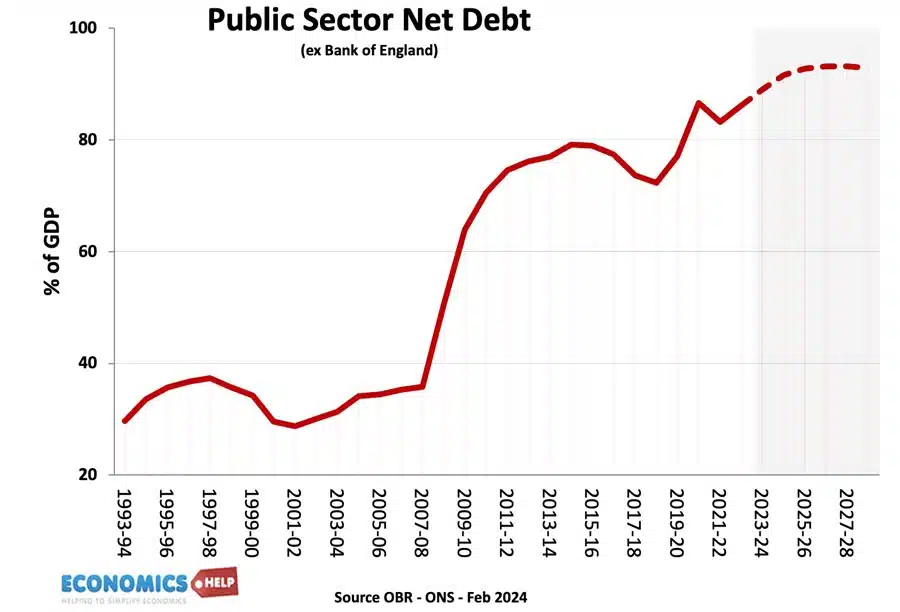
Public sector debt psf at ONS PSND % GDP
Labour productivity prdy dataset lab. prod. % change
Saving Ratio Nat.l inc. acc: J3 household savings %
Business investment Business investment
Housing market Nationwide data house price index ONS
UK wage growth average earnings S.A % change
Industrial + manuf output industrial production index of output

Bank of England data
UK Bond yields Bank of England 10 year bond yields
Exchange rates Sterling exchange rate
Money supply (BM4 at B of E)

Other data

Readers Questions: I’m pretty good at finding data at FRED. But I have no luck finding what I want at ONS. Do you have a post on that? Or some guidelines that might help me? Would be great!

It’s a good question. I’ve spent the past four years finding my way around the ONS database and website (and updating links the last time they changed URLs). I’ve spent many hours looking for certain statistics. The good news is that nearly all the important ones are there, if you dig hard enough. Though some data like exchange rates, bond yields, interest rates and money supply you will need Bank of England database.

Sometimes it’s frustrating because all you want is the % change in real GDP, and you have to wade through statistics on S.A Output in fishing and forestry.

A few points.

  1. If you get stuck, ONS have been very helpful in pointing out to me the relevant page. So it might be worth using the contact page, if you do get stuck
  2. Sometimes, the hardest thing is knowing where to find a statistic. For example, finding the savings ratio was difficult, because it’s not intuitive you need to look in National accounts – Household sector – saving ratio
  3. In some cases, other sources of data are better, e.g. for housing I still think Nationwide is better than the ONS, though the ONS seem to be giving housing more importance.
  4. It’s also worth checking out:

Tips on getting data

I subscribe to the ONS RSS feed so I can see when new publications come out.

Continue Reading →

Comments { 1 }