Tag Archives | inflation

Producer Inflation

Another guide to inflationary pressures is the producer price index (PPI).

Producer inflation measures the price of goods produced by manufacturing firms. This is sometimes referred to as ‘factor gate prices’

producer-inflation

In the year to February 2013 the output price index for home sales of manufactured products rose 2.3%. In the same period the total input price index rose by 2.5%.

Narrow measure of producer prices

The narrow measure of producer prices excludes industries which tend to be more volatile. This volatile industries included food, beverages, tobacco and petroleum industries. Excluding these industries, the producer price inflation has been lower during this period.

Input prices

Input prices are the cost of raw materials used in the manufacturing process. This will involve the cost of metals, plastic, oil and other raw commodities.

input-prices

Again, there is a narrow measure of input prices, which excludes the more volatile industries of food, oil, tobacco, beverages and petroleum. This graph shows the quite significant input price inflation during 2011.

Leading indicators

Producer and input prices are known as ‘leading indicators’. This is because they will tend to influence future inflationary pressures. If input prices rise, firms will put up their producer prices, and in turn, this is likely to translate into higher consumer retail prices.

Continue Reading →

Comments { 1 }

UK Inflation Rate and Graphs

Current UK Inflation Rate

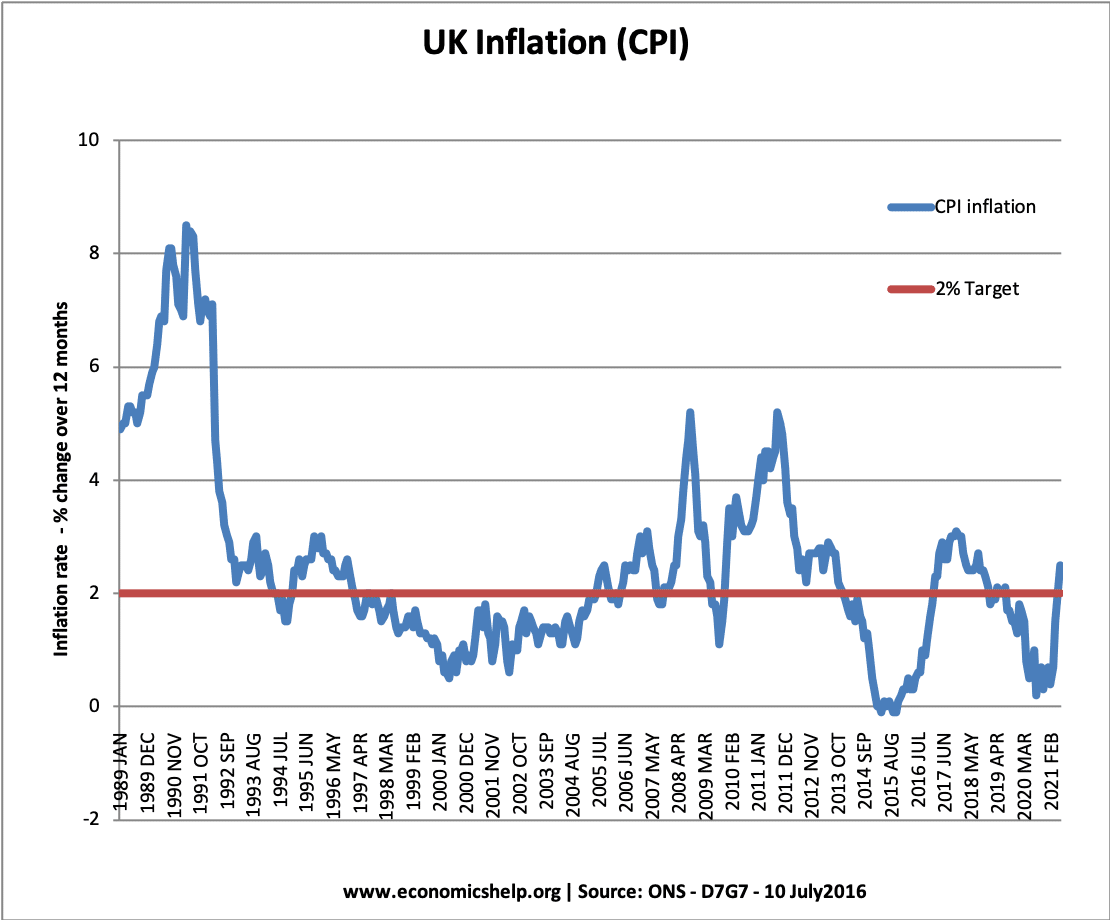
  • CPI  inflation rate: 2.8% (headline rate)
  • CPIH inflation: 2.6% (CPIH includes household costs, such as mortgage payments)
  • Inflation is a measure of the annual % change in the cost of living. (page updated March 19, 2013)

cpi-inflation

  • CPI  inflation increased to 2.8%  in Feb 2013.
  • The largest upward contributions to the CPI came from increases in gas and electricity bills and from price changes for some recreational goods, motor fuels and air transport.
  • Raw data inflation time series | CPI annual % change at ONS

CPI and CPIH

CPIH is a new experimental index from the ONS. It is based on CPI, plus it includes housing costs, such as mortgage interest payments. Owner occupiers cost (OOH) account for 12% of the CPIH weighting. Mortgage interest payments are the biggest part of OOH. Mortgage interest payments average 10% of household expenditure.

cpi-cpih-inflation

Continue Reading →

Comments { 4 }

Index of labour costs per hour

A new series from the ONS shows an index of labour costs per hour.

unit-labour-costs

Source:  ONS 

(this is an experimental series and looks as if it is not seasonally adjusted) Labour costs seem to be persistently highest in Q1.

Labour costs per hour are primarily comprised of 

1. Wage costs per hour

but also

2. Non-wage costs.

Non wage costs of labour include:

  • National Insurance Contributions, (NI)
  • Employee Pension Contributions,
  • Sickness, Maternity and Paternity Payments
  • Benefits in kind

Growth in wage costs per hour

index-labour-costs-hour-percent-change

As expected, since 2008, we have seen very modest increases in unit labour costs. In the last quarter Q4 2012, labour costs were actually 0.8% lower than the previous quarter in 2011. Continue Reading →

Comments { 1 }

RPIJ – a new inflation measure

For those who like to keep track of the myriad different rates of inflation, the ONS will shortly be publishing a new measure – RPIJ.

  • RPIJ will be basically RPI, but calculated in the same way as CPI which uses a geometric mean.
  • CPI = official household inflation measure (CPI) – calculated using a geometric mean.
  • RPI = CPI + Mortgage interest payments and council tax. RPI is also calculated using an arithmetic mean. (The RPI doesn’t mean international standards for calculating inflation.)

gap-between-rpi-cpi

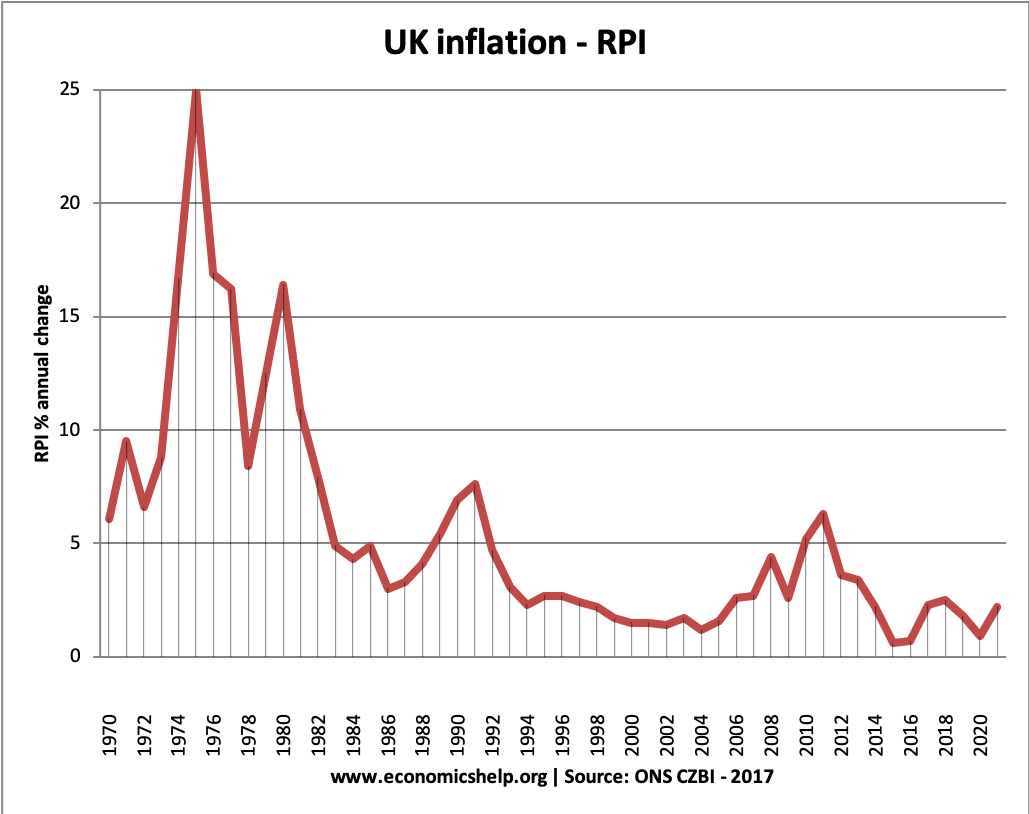
RPI is traditionally higher than CPI. The DWF state since its introduction in 1988, the RPI has averaged 0.73% more than the CPI which is mainly attributable to the “formula effect”. Some argue, because of the way it is being calculated, the RPI is over-estimating inflation. However, with pensions often linked to RPI, changing the way it is calculated could lead to lower annual increases in pensions. Therefore, the decision was taken to introduce a new measure RPIJ and keep the old measure RPI going.

Continue Reading →

Comments { 2 }

Different Measures of Inflation

In the UK, there are quite a few different measures of inflation. All measures seek to show the annual change in living costs. However, different measures of inflation give different inflation figures. For example, RPI often gave a higher rate of inflation than CPI. CPI can also be misleading. For example, an increase in VAT would cause CPI to increase, but a core inflation measure like CPI-CT, would stay lower

It is important to be aware of different measures of inflation because the rate of inflation has an important bearing on monetary policy.

Usually, an inflation rate of CPI 4.5% would encourage the Bank of England to raise interest rates. But, if this inflation rate was due to cost-push factors, such as higher taxes, the inflation rate may not be due to overheating in the economy.

Inflation is calculated by:

  • Finding out the most commonly bought goods (e.g. Family expenditure survey)
  • Measuring the change in prices and then applying the weight of the good to the price change.


Different Measures of Inflation

1. Consumer Price Index (CPI) – official measure. Based on the EU HCIP (Harmonised Consumer index prices)

  • Includes taxes.
  • Excludes mortgage interest payments and housing costs
  • Includes some financial services not included in RPI

cpi-inflation

Continue Reading →

Comments { 3 }

The wrong and right kind of inflation

I like this article about the wrong kind of inflation by Roger Bootle

Or as his cleaner said:

“It’s not the inflation they need to sort out, Mr Bootle, it’s the rising prices!”

Essentially, the wrong kind of inflation is  cost-push inflation. This inflation is due to rising costs of production, such as rising energy prices, rising transport costs, imported inflation and rising food prices. This inflation causes a shift to the left of short run aggregate supply. A simple SRAS / AD diagram shows how this kind of inflation also causes a fall in real GDP.

The wrong kind of inflation
inflation

Cost push inflation, causing rising prices and falling real GDP.  (note some textbooks may show SRAS as a straight-line, but the principle is the same)

This wrong kind of inflation leads to a fall in living standards.  Since 2008, the UK has seen a fall in real wages. We have had the worst of both worlds – rising prices, but falling incomes (or at least stagnant incomes)

This bad type of inflation doesn’t cause a rise in wages. But, a fall in real wages. We may laugh at Mrs Bootle’s cleaner, but in a way she might be trying to say, inflation isn’t a problem, if money wages keep up. If money wages grow faster than inflation, then we can afford the rising prices. Our income has increased to meet the higher cost of living.

Continue Reading →

Comments { 3 }

Economic Problems Facing Pakistan

Readers Question: In this era, Inflation had gotten really high specially in countries like Pakistan. Hows will the Inflation level go down ? or will it even let the country develop ?
Inflation is one of the several problems that the Pakistan economy faces. The good news is that inflation has been falling in the past two years. But, it is still one of the highest in the region; and in addition to inflation, there are also other inter-related problems the Pakistani economy faces.

Pakistan has a forecast of real GDP growth of 3.25% in 2013 – but, given the rise in the population, this growth is insufficient to improve living standards. Real GDP per capita growth has been stagnant in recent years. (real GDP per capita – measures output per person)

 Inflation in Pakistan

Inflation peaked at 20% in 2009 and has now fallen to just under 7% at the end of 2012. However, many expect inflation to increase back up above 10% – because of cost-push factors.

pakistan-inflation

Causes of Inflation in Pakistan include:

  • Rising energy prices.
  • Rising food prices. Agriculture is one of the mainstays of the Pakistan economy with 45% of the labour force employed in agriculture. However, the country has faced food shortages, pushing up food prices. Continue Reading →
Comments { 0 }

Inflation and Exchange Rates

Readers Question: Why is it that the value of the exchange rate falls when there is higher inflation?…in the quantitative easing section (from Euro to Pound)

How Inflation Affects Exchange Rates

A relatively higher inflation rate in the UK compared to other countries will tend to reduce the value of pound because:

  • High inflation in the UK means that UK goods increase in price quicker than European goods. Therefore UK goods become less competitive. Demand for UK exports will fall. Therefore there will be less demand for Pound Sterling.
  • Also, UK consumers will find it more attractive to buy European imports. Therefore they will supply pounds to be able to buy Euros and the Euro imports. This increase in the supply of pounds decreases value of Pound Sterling.

Therefore in the long run, changes in relative inflation rates should lead to a change in exchange rates.

Also markets anticipate future inflation. If they see a policy likely to cause inflation then they will tend to sell that currency causing it to fall in anticipation of the inflation.

How the Exchange Rate Affects Inflation

If there is a depreciation in the exchange rate, this depreciation should cause inflation to increase.

A depreciation means the currency buys less foreign exchange, therefore, imports are more expensive and exports are cheaper. Therefore, we get:

  • Imported inflation. The price of imported goods will go up because they are more expensive to buy from abroad
  • Higher domestic demand. Cheaper exports increases demand for UK exports. Therefore, there is an increase in domestic aggregate demand, and we may get demand pull inflation.
  • Less incentive to cut costs. Manufacturers who export see an improvement in competitiveness without making any effort. Some argue this may reduce their incentive to cut costs, and therefore, we get higher inflation over the long term.

Therefore, a depreciation causes both cost-push inflation and demand pull inflation.

Example of Depreciation Causing Inflation in UK

sterling

During 2007 and 2008, we saw a significant fall in in the value of the Pound.  This caused some inflation.

inflation

The UK did experience a spike in inflation towards the end of 2008.

Evaluation of impact on inflation.

  • The rise in UK inflation in 2008 was also due to  higher oil prices.
  • The effect on inflation was limited because in 2009 the UK was in recession, which reduced inflation.
  • The impact also depends on elasticity of demand and whether firms will pass on the exchange rate costs onto consumers. For example, firms may reduce profit margins rather than increase the price of impots.


Comments { 1 }

Difficulties of Calculating inflation

Inflation is calculated by measuring price changes and multiplying price changes by the weighting attached to the different goods.

However, there are many different ways of calculating inflation which can lead to different results.

Some Issues With Calculating Inflation

  • The family expenditure survey is limited to only 6,000 households. However, these may be unrepresentative. Also, it is only updated once a year, but people’s spending habits change frequently. eg. if a new version of the iphone comes out, it might not be in  the FES for a while.
  • People may have different inflation rates. For example, old people spend a higher % of income on fuel and public transport. Therefore if these goods increase  in price old people may be relatively worse off (especially if pensions are index linked). In recent years, we have experienced a higher rate of inflation for energy and food. People on lower incomes, tend to spend a higher % of their income on food and fuel – so effectively, they have a higher inflation rate.
  • Changes in Quality of Goods. e.g. if mobile phones become more expensive, is this due to inflation or better quality goods? Official statistics bodies do attempt to take into account changes in the quality of products, but this process is quite subjective. It is hard to know the extent to which more expensive phones should count as inflation or improved quality.
  • Different measures of Inflation. As well as CPI, the government also calculate different methods of inflation like RPI and RPIX. RPI includes housing costs and therefore, recently has given a higher value of inflation. See: Differences between RPI, RPIX and CPI
  • Chain Weighted Index. If the price of one good goes up, it may automatically change peoples spending patterns. Therefore, they stop buying the more expensive goods. Therefore, the price that they actually pay stays the same. A Chain Weighted index takes these changes in quantity into account.
  • Core Inflation. Often there may be a temporary spike in inflation because of a rise in volatile goods such as energy prices and food. Therefore, the headline CPI rate may give a misleading impression to underlying inflation. See: difference between CPI and Core CPI inflation

Example of Core Inflation and CPI inflation in the US

Core CPI

Source: 1

  • Blue line – CPI
  • red line – Core CPI – without volatile prices.

In 2008, the US experienced a jump in headline CPI inflation, but this included a temporary increase in oil prices. In 2009, oil prices fell causing a fall in headline rate.

Attempts to Overcome the difficulties of calculating inflation

  • The Billion price project is an attempt to include a much wider range of published prices across the internet. BPP index at Mit

Related

Comments { 2 }

The Real Rate of Inflation

In the UK there is a strong mistrust of the government’s inflation figures. People often feel that their cost of living is rising faster than official CPI statistics.

CPI inflation is calculated using a comprehensive price survey of 1000 of the most popular goods and services. However, there are a number of reasons why people feel inflation is increasing faster than government statistics.

1. CPI excludes housing costs. The official measure for inflation used to be the RPI. RPI inflation is currently higher than CPI; RPI inflation is closer to 4%.

The CPI also excludes the council tax increases that have been rising faster than inflation.
inflation
2. There is a variance within the average basket of goods. The average inflation rate is 4%, but some goods like food, energy and petrol prices are rising by up to 15%. If you spend a high % of your income on these goods your personal inflation rate will be higher than the average inflation rate. For example, the inflation rate for many pensioners is higher than the average because they spend a high % of their income on energy and food. However, if you spend a large % of your income on electronic goods your personal inflation rate may be less than the national average.
inflation

Graph shows that electricity prices are much more volatile than average inflation. If a high % of your income is spent on fuel, you will have a higher personal inflation rate. See also: fuel poverty

  • Some people who may be adversely affected are those who are currently re-mortgaging. The cost of a fixed rate is significantly higher than 2 years ago. Their effective cost of living may be increasing very significantly at the moment. This is ignored by the CPI.

3. Psychology. You might argue that people tend to remember bad news more than good news. For example, the increasing price of petrol is well documented by the media and there are constant reminders as you drive around. However, it is easier to forget that the price of computers and mobile phones are becoming better value. Therefore, because we give more weight to ‘bad news’ rather than ‘good news’ our perceptions on inflation may be wrong.


Related

Comments { 0 }